
After leaving a job, many face a question that seems simple but is actually very important: What should I do with my former employer’s 401(k) account?
This article uses a hypothetical case study to explain whether and how to handle a retirement account rollover. Different choices can affect future taxes, investment options, account fees, retirement income, Required Minimum Distributions (RMDs), asset management, and wealth transfer.
Part I: General Overview of the Case Study
Case Scenario: What Should You Do with a $500,000 401(k) After Changing Jobs?
If you leave a company and have $500,000 in your former employer’s 401(k), what would you do with it?
Many people’s first reaction might be:
“Just roll it over into an IRA.”
In reality, however, there is no single rollover option that is automatically right for everyone.
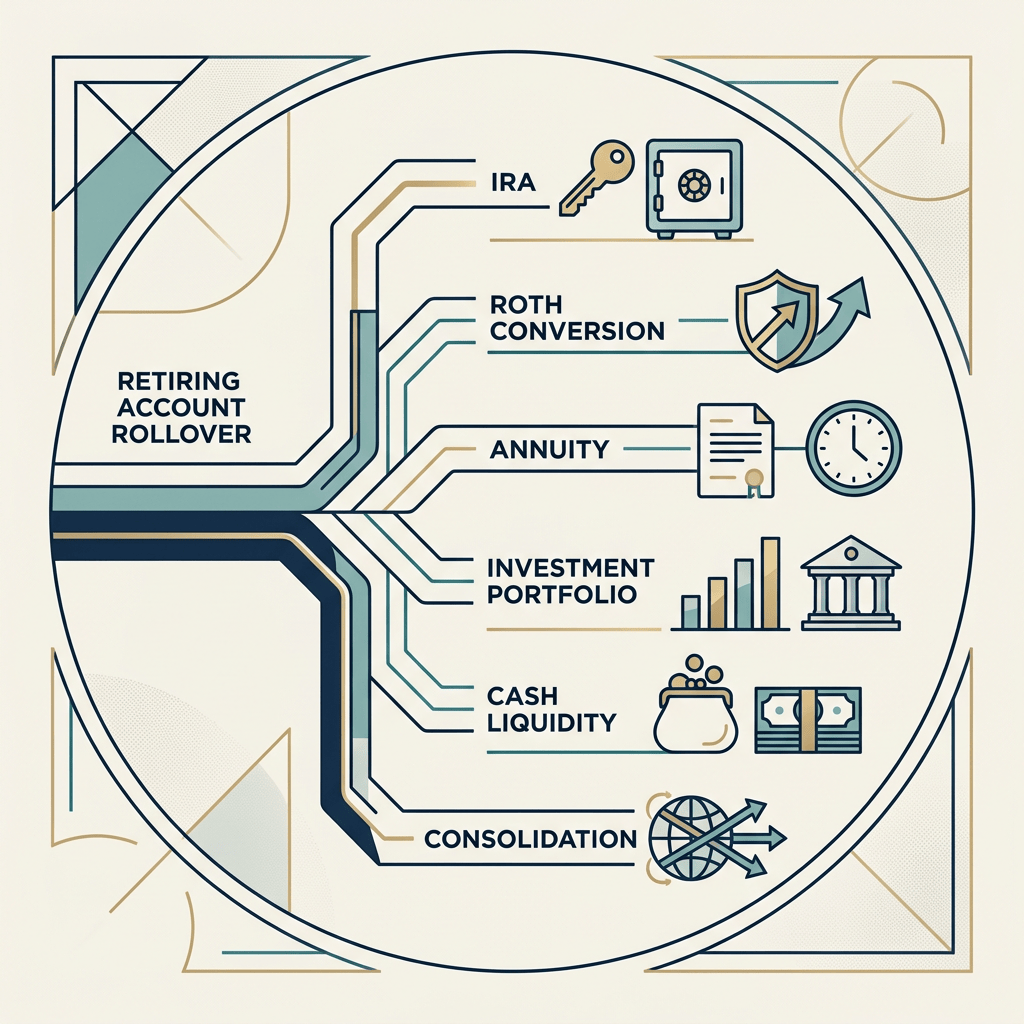
After leaving an employer, there are at least six possible options for handling a $500,000 retirement account:
- Leave it in the original 401(k).
- Roll it over into the new employer’s 401(k).
- Roll it over into a Traditional IRA / Rollover IRA.
- Convert it to a Roth IRA.
- Transfer it into an IRA or another eligible account and use some of the funds to purchase an annuity.
- Withdraw the money as cash (Cash Out).
These six options may lead to very different outcomes in terms of:
- Tax consequences
- Investment options
- Fees
- Liquidity
- Retirement income
- Required Minimum Distributions (RMDs)
- Roth Conversion opportunities
- Wealth transfer outcomes
Therefore, the real question about a rollover is not simply, “Should I move the money?” but rather, “Where should the money go, and why is that option appropriate for me?”
Let’s Look at a $500,000 Case Study
Suppose David is 56 years old. He has worked for his former employer for 20 years and has accumulated $500,000 in his 401(k). David now leaves his former employer and starts a new job.
His basic circumstances are as follows:
- Age: 56
- Former 401(k) balance: $500,000
- Entire balance consists of Traditional / pre-tax funds
- No Roth 401(k) balance
- Three and a half years until age 59½
- Assumed long-term annual investment return: 6%
- Assumed future marginal income tax rate in retirement: 25%
- For comparison purposes, Social Security, other retirement assets, and pensions are not considered
- Differences in fees among specific investment products are excluded
To make the comparison more straightforward, assume the $500,000 remains invested for 10 years and earns an average annual return of 6%.
The result would be:
$500,000 → Approximately $895,000
In other words, if there are no additional contributions or withdrawals, the account could grow to approximately $895,000 over 10 years through long-term compounding at 6% annually.
But here is the important question: How much of that $895,000 will ultimately belong to David after taxes?
The answer depends on the rollover option he chooses today.
Part II: A Detailed Comparison of Different Rollover Options
1. Option One: Leave It in the Original 401(k)
This is an option that many people overlook.
In this example, David can simply do nothing and leave the money in his former employer’s 401(k).
Assuming the investment return remains 6%, the account would grow as follows after 10 years:
$500,000 → $895,424
If David withdraws the entire balance in retirement and pays an assumed effective tax rate of 25%, the after-tax amount would be:
$895,424 × 75% = Approximately $671,568 after tax
Advantages of This Option
First, it is simple. David does not need to make any immediate account transfers.
In addition, his original 401(k) may offer:
- Low-cost institutional funds
- Stable Value Funds
- Target Date Funds
- Specialized investment options offered by the employer
If the original 401(k) plan is particularly attractive, leaving the money where it is may be a reasonable choice.
Another Important Advantage: The Rule of 55
In this example, David is 56 years old and leaves his former employer at age 56.
This makes one rule particularly important.
If an eligible participant separates from service during or after the calendar year in which they turn 55, certain withdrawals from that employer’s 401(k) may qualify for the Rule of 55 exception, avoiding the usual 10% early-distribution additional tax.
This could be very important for David.
If he rolls the entire $500,000 into an IRA:
401(k) → IRA
the funds will then be subject to IRA withdrawal rules.
If David needs to access the money before age 59½, the original 401(k) and a Rollover IRA may have important differences in the availability of early-withdrawal exceptions.
Therefore, for people approaching age 55 or older, an immediate rollover is not necessarily the best answer.
2. Option Two: Roll It Over into the New Employer’s 401(k)
Suppose David starts his new job. If his new employer’s 401(k) plan accepts rollovers, he may be able to transfer the funds as follows:
Old 401(k) → New 401(k)
Assuming the new employer’s 401(k) also earns an annual return of 6%, the account would grow to approximately $895,424 after 10 years.
At first glance, this appears no different from leaving the money in the original 401(k).
However, the real comparison is between the original and new 401(k) plans.
The following factors should be evaluated individually:
| Item | Original 401(k) | New 401(k) |
| Investment options | ? | ? |
| Fund expenses | ? | ? |
| Administrative fees | ? | ? |
| Employer matching contributions | None from former employer | May be available |
| Stable Value Fund | May be available | May be available |
| Roth 401(k) | May be available | May be available |
| Loan feature | May be available | May be available |
| Rule of 55 | May apply | Depends on the circumstances |
| Ease of account management | Lower if accounts are spread out | Potentially higher |
Therefore, a new 401(k) is not necessarily better than the old one. The plans themselves must be compared.
3. Option Three: Rollover IRA
This is one of the most familiar options.
David can transfer the funds as follows:
Old 401(k) → Rollover IRA
If he uses a Direct Rollover, the transfer generally does not trigger current income tax.
The IRS explains that a retirement plan can directly transfer an eligible distribution to another eligible retirement plan or IRA. With a direct rollover, federal income tax withholding generally does not apply to the transferred amount.
The result would be:
- Transfer amount: $500,000
- Destination: Rollover IRA
- Current tax: Generally $0
- IRA balance after the rollover: $500,000
If the account continues to grow at 6% annually for 10 years:
$500,000 → $895,424
Assuming a 25% effective tax rate on withdrawals in retirement:
$895,424 × 75% = Approximately $671,568 after tax
One of the Biggest Advantages of an IRA: Investment Choices
An IRA generally offers a broader range of investment options than an individual employer’s 401(k) plan.
Examples include:
- ETFs
- Mutual Funds
- Bonds
- CDs
- Money Market Funds
- Stocks
- Managed Portfolios
- Annuities, in certain circumstances
Therefore, if David wants to build a more personalized retirement investment portfolio, an IRA may offer greater flexibility.
An Often-Overlooked Issue with a Rollover IRA
Suppose David also wants to use a Backdoor Roth IRA strategy in the future.
His Traditional IRA / Rollover IRA balance may create complications under the pro-rata rule.
Therefore, although a transfer from a 401(k) to an IRA may seem straightforward, it does not necessarily represent the best choice for future tax planning.
If someone expects to have a high income over the next several years and is considering Roth Conversions or Backdoor Roth IRA contributions, it is advisable to evaluate the overall retirement account structure before completing the rollover.
4. Option Four: Roth Conversion
This is one of the most frequently misunderstood options.
In this example, David could transfer the funds as follows:
401(k) → Roth IRA
However, this is fundamentally different from an ordinary rollover.
A transfer from a Traditional 401(k) to a Traditional IRA is generally a tax-deferred rollover.
By contrast, a transfer from a Traditional 401(k) to a Roth IRA generally involves a taxable Roth Conversion.
The IRS generally requires previously untaxed amounts converted to a Roth IRA to be included in taxable income for the year of conversion.
What Happens If David Converts the Entire $500,000 to a Roth IRA at Once?
For illustration purposes, assume a hypothetical combined marginal tax rate of 35%.
Note that this does not mean David would necessarily pay 35% in actual taxes.
His actual tax liability would depend on:
- Filing status
- Taxable income
- Deductions
- Tax brackets
- State income taxes
- Other income
- The amount converted to a Roth IRA
The following calculation is intended only to illustrate the concept.
The estimated tax would be:
$500,000 × 35% = $175,000
In other words, if David converts $500,000 to a Roth IRA today, the assumed tax liability would be $175,000 under this hypothetical tax-rate assumption.
If the $500,000 invested in the Roth IRA continues to earn 6% annually, the account would grow to approximately $895,424 after 10 years.
If the Roth IRA distribution satisfies the applicable qualified-distribution requirements, future withdrawals may be free of federal income tax.
Therefore:
$895,424 → Potential after-tax value of $895,424
By comparison, if David withdraws the same amount from a Traditional 401(k) or Traditional IRA and pays an assumed 25% effective tax rate:
$895,424 × 75% ≈ $671,568
At first glance, the comparison looks like this:
| Item | Traditional IRA | Roth IRA |
| Account value after 10 years | $895,424 | $895,424 |
| Assumed future tax rate | 25% | 0% on qualified distributions |
| After-tax value | $671,568 | $895,424 |
The Roth IRA appears to provide approximately $223,856 more in after-tax value.
However, there is one extremely important assumption behind this comparison:
The $175,000 in taxes required for the Roth Conversion must be paid from other funds, rather than taken out of the retirement account to pay the tax bill.
Otherwise, the mathematical results would be very different.
A Potentially More Practical Approach: Avoid Converting the Entire $500,000 at Once
This is one of the central principles of Roth Conversion planning.
David could consider spreading the conversion over several years:
$500,000
↓
Spread over several years
↓
Convert a portion each year
For example:
- Year 1: $100,000
- Year 2: $100,000
- Year 3: $100,000
- And so on
Instead of converting the entire $500,000 at once, David could evaluate how much to convert each year.
Why?
Because the U.S. federal income tax system uses progressive tax brackets. Adding $500,000 of taxable income in a single year could push part of that income into significantly higher tax brackets.
Therefore:
A rollover is primarily an account-transfer decision, while a Roth Conversion is primarily a tax-planning decision.
These two issues should not be confused.
5. Option Five: Use a Portion of the Funds to Purchase an Annuity
Now let’s consider an option that deserves careful attention in retirement planning.
David does not necessarily need to keep the entire $500,000 invested in a stock and bond portfolio.
He could consider:
Rollover IRA / 401(k) → IRA → Annuity
Alternatively, where permitted, he may be able to arrange an eligible annuity investment through a retirement plan.
It is important to emphasize that an annuity is not a single type of product. Different annuities serve very different purposes.
Examples include:
- Fixed Annuity
- Variable Annuity
- Fixed Indexed Annuity
- Immediate Annuity
- Deferred Income Annuity
- Hybrid / Long-Term-Care Annuity
- Registered Index-Linked Annuity (RILA)
- Qualified Longevity Annuity Contract (QLAC)
Therefore, it is not sufficient to say, “Roll the 401(k) into an annuity.”
The real question should be:
How much retirement income will I need to maintain my desired standard of living after I retire?
Suppose David Uses $200,000 to Purchase a Retirement Income Annuity
Assume the following allocation:
- $200,000 → Annuity
- $300,000 → IRA / Investment Portfolio
This creates a typical “Income Floor + Growth” strategy.
For example:
$200,000
↓
Lifetime Income / Guaranteed Income
Plus
$300,000
↓
Investment Portfolio
With this approach, David does not put all his assets into growth-oriented investments, nor does he lock all his assets into guaranteed-income products.
Instead, one portion of his assets provides guaranteed lifetime income, while the other portion remains available for growth, liquidity, and wealth transfer.
The Key to an Annuity Is Not Simply Its “Rate of Return,” but Its Guaranteed-Income Function
Suppose a particular annuity offers an illustrative lifetime income payout rate of 5.5%.
Important: A 5.5% payout rate is not the same as a 5.5% investment return.
For illustration, it might represent the annual income payable under the assumed contract terms:
$200,000 × 5.5% = $11,000 per year
That is approximately:
$917 per month
If the annuity provides joint lifetime income for David and his spouse, the payout amount will generally also depend on factors such as:
- David’s age
- His spouse’s age
- Payout option
- Inflation adjustment option
- Death benefit
- Contract terms
Therefore, when evaluating an annuity, it is not enough to ask:
“What is the rate of return?”
A more useful question is:
“How much lifetime income protection can I obtain in exchange for the amount I invest?”
These are two very different ways of evaluating an annuity.
6. Option Six: Cash Out — Withdraw the Entire $500,000
This is the simplest option, but it often carries the greatest tax cost.
In this example, David could withdraw the funds as follows:
401(k) → Cash
Assume the entire $500,000 consists of taxable pre-tax money.
If David leaves his job at age 56 and qualifies for the Rule of 55 exception, certain withdrawals from that employer’s 401(k) may avoid the 10% early-distribution additional tax.
However, ordinary income tax may still apply.
For simplicity, assume an illustrative effective tax rate of 25%.
Estimated income tax:
$500,000 × 25% = $125,000
Estimated after-tax amount:
$500,000 − $125,000 = $375,000
David would receive approximately $375,000 after the assumed income tax.
Another Very Important Issue: 20% Withholding
Suppose David does not use a Direct Rollover and instead asks his 401(k) plan to pay the money directly to him.
For an eligible rollover distribution from an employer retirement plan paid directly to the participant, mandatory 20% federal income tax withholding generally applies.
The IRS explains that eligible rollover distributions paid directly to individuals from employer retirement plans, such as 401(k) plans, generally require 20% federal withholding. A Direct Rollover generally avoids this withholding.
For example:
- Distribution: $500,000
- Amount received after 20% withholding: $400,000
- Federal income tax withheld: $100,000
If David wants to complete a rollover of the entire $500,000 within 60 days, he must find another $100,000 from his own funds to make up the difference.
Otherwise, only the $400,000 actually rolled over would be included in the rollover, while the remaining amount could be treated as a taxable distribution.
The IRS generally requires a 60-day rollover to be completed within 60 days after the distribution is received.
Therefore, when a Direct Rollover is available, it is generally preferable to avoid having the 401(k) funds paid to your personal bank account first.
Part III: Comparing All Six Options Side by Side
Now let’s compare the six rollover options available to David for his original $500,000 401(k).
Assumptions
- Initial balance: $500,000
- Investment period: 10 years
- Annual investment growth: 6%
- Assumed effective tax rate on Traditional account withdrawals in retirement: 25%
- Assumed tax rate for Roth Conversion calculations: 35%
- All figures are illustrative examples, not individual tax projections
| Option | Today | Illustrative Value After 10 Years | Tax Treatment | Key Feature |
| Leave in original 401(k) | $500K | $895K | Tax-deferred | Simple; may preserve Rule of 55 access |
| New 401(k) | $500K | $895K | Tax-deferred | Consolidation; depends on the new plan |
| Rollover IRA | $500K | $895K | Tax-deferred | Broader investment choices |
| Roth Conversion | $500K | $895K | Taxes paid today | Qualified future withdrawals can be tax-free |
| Annuity | For example, $200K | Depends on the contract | Generally tax-deferred when appropriately structured | Focus on lifetime income protection |
| Cash Out | Cash received | Depends on whether the proceeds are reinvested | Taxable in the year of distribution | Highest liquidity; often the greatest immediate tax cost |
The most important question is not necessarily:
“Which account will have the most money after 10 years?”
Under the same assumed investment return, a Traditional 401(k), Traditional IRA, and new 401(k) could all produce the same pre-tax result.
The real differences involve the following questions:
- When will taxes be paid?
- Where will the money be held?
- What investment options are available?
- When can the money be withdrawn?
- How will the assets generate retirement income?
- How can future Roth Conversions be managed?
- How will the assets ultimately be transferred to the next generation?
In simple terms:
Leave in Old 401(k): Maintain the Status Quo
Suitable for people whose existing plan is particularly attractive and who want to preserve its features.
New 401(k): Consolidation
Suitable for people who want fewer accounts and whose new employer offers a high-quality retirement plan.
Rollover IRA: Flexibility
Suitable for people who want broader investment choices and more centralized management of their retirement assets.
Roth Conversion: Pay Taxes Earlier in Exchange for Potential Future Tax Advantages
Suitable for people who want to manage their long-term tax exposure.
Annuity: Convert a Portion of Assets into Income Protection
Suitable for retirees who need additional guaranteed income to help support their retirement lifestyle.
Cash Out: Liquidity
Suitable for people who genuinely need the funds and determine, after careful tax and retirement-planning analysis, that a withdrawal is worthwhile.
However, for most long-term retirement plans, a Cash Out decision should generally be made only after careful analysis, rather than automatically following a job change.



Leave a Reply